

Pull up a chair.
The other day I overheard a conversation at the break table at work. Yes, I still work. Somebody has to pay the bills, and the dogs have expensive opinions about dinner.
A co-worker of mine was upset, and wanted the school to block AI. All of it. Every bit. Their child had a school-issued laptop and was on AI constantly at home, and the parent had reached the end of their patience with it.
I did not join in. I am sixty-something and I have learned that the break table is rarely where minds get changed. I took my coffee back to my desk.
And then I was in 1972.
Mrs. Smith, Fifth Period
Tenth grade algebra. Middle of the room, three seats back. It is remarkable to me which memories keep their furniture — I could not tell you what I had for lunch last Thursday, but I can tell you exactly where that desk sat.
Mrs. Smith was teaching the commutative and associative laws. For anyone who has let that drift: the commutative law says you can swap the order — two plus three is three plus two. The associative law says you can regroup — it does not matter which pair you add first. Simple ideas with formal clothes on.
And I was not getting it.
I want to be clear that I was not bored and I was not being a smart aleck. I thought it was interesting. I just could not make it sit down in my head the way she was saying it.
So I raised my hand. She called on me. And I asked the question that any teacher in the world ought to want:
“Can you explain this a little differently? I don’t understand it.”
Wrong question.
“You’re making fun of me,” she said. “Sit outside the classroom until I let you back in.”
So I sat outside. That period, and the next day too, when I walked back in and was thrown right back out. And the day after that.
I sat in that hallway during fifth period for three weeks.
What I Did Not Know At Sixteen
Here is the part I only understood much later, with the particular clarity that shows up twenty years after it would have been useful.
Mrs. Smith was an English teacher.
She had been assigned to teach math, the way schools did then and still do when the schedule has a hole in it and a warm body is available. She was not a bad woman. She was a woman standing in front of thirty teenagers with her trusty teacher’s edition algebra textbook, teaching something she had not been trained to teach, every single day, with no net.
And a sixteen-year-old raised his hand and asked her to explain it another way.
She did not have another way. That is the whole thing. She had the one explanation in the book, she had already given it, and a kid in the middle of the room had just asked her, in front of everybody, for the one thing she did not have.
So she called it mockery and put me in the hall. Not because I was mocking her. Because being thought cruel was easier than being found out.
Looking back now, I may well have understood those two laws better than she did. That is not a victory. There is no winning in that story. There is a scared teacher and a kid in a hallway, and a school district that put them both there.
What I Keep Thinking About
Here is where my mind went, sitting at my desk with my coffee going cold.
If I had had a laptop in that hallway — if I had had what my grandchildren have in their backpacks — I would have had that question answered in four minutes.
And not just answered. Answered differently. Then differently again. I could have said “explain it like I’m fifteen,” and then “give me an example with money,” and then “show me where I’m going wrong,” and I could have asked it eleven times without anyone sighing at me or getting embarrassed or sending me anywhere.
That is the thing people miss about asking a machine. Not that it is smarter. That it does not get tired of you.
And I will tell you something else. I would not have minded one bit if Mrs. Smith had been standing behind me watching the screen. Not a bit. Because I would not have been cheating. I would have been doing the thing I had raised my hand to do in the first place.
That is the whole distinction, and we are going to come back to it.
It Is Not Going Anywhere
Now let me say the unpopular part plainly, and then say it again, because the break table needs to hear it twice.
AI is not going away.
Call it AI, call it SI, call it whatever the marketing people land on next quarter. It is not going anywhere. It is going to grow, and it is going to keep growing, and no district policy is going to put it back in the tube.
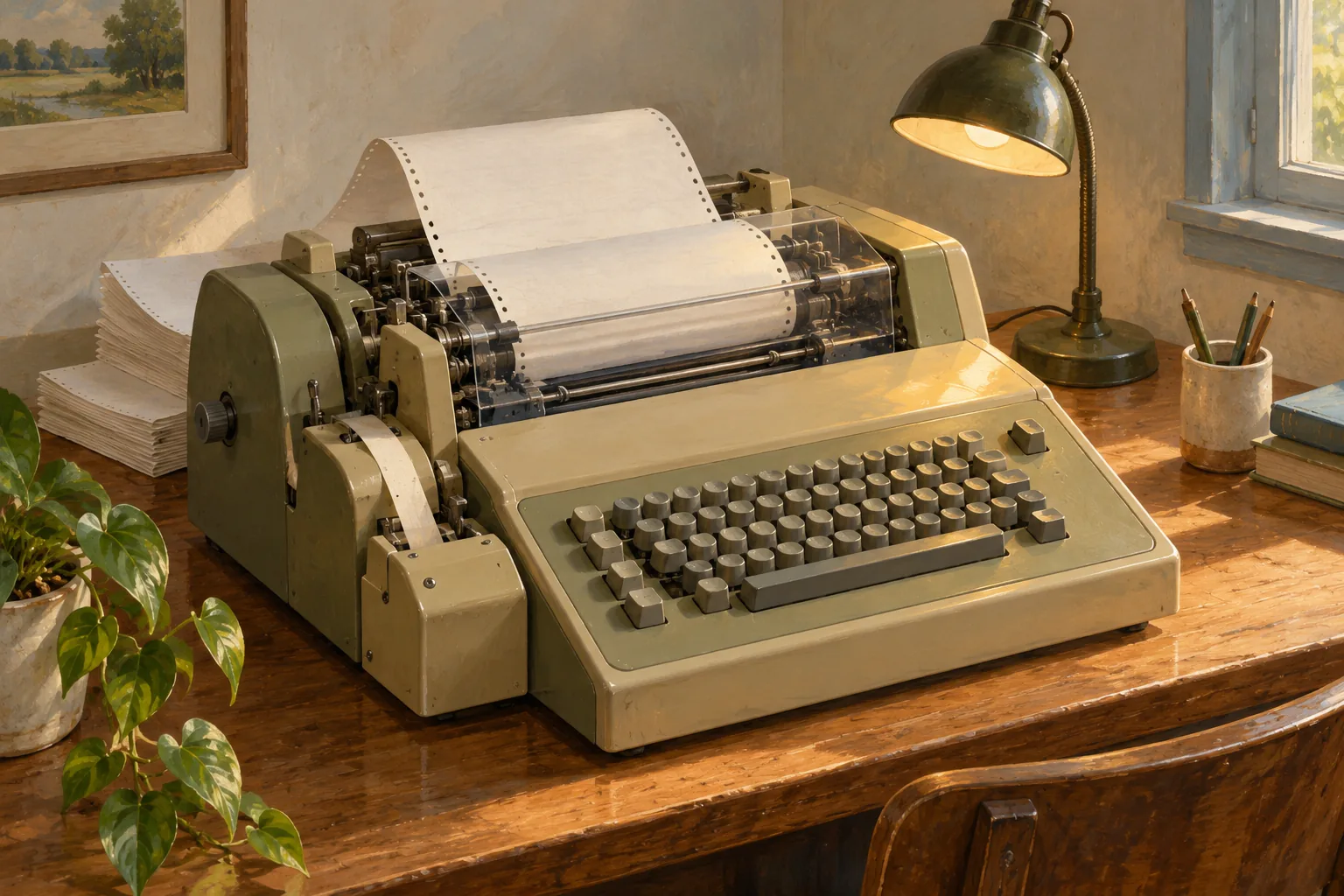
I have been hanging around technology since 1978 — and before that, Jimmy and I knew a computer scientist who brought us a minicomputer with a teletype interface. I have written about Jimmy before. We sat there feeding paper into that thing and I have honestly never recovered. That was the flick of the flame. Everything after it has been the forest fire.
So I have watched a few of these arrive. And every single time, the shape of the argument is identical.
Calculators would destroy arithmetic. Word processors would destroy handwriting. Wikipedia would destroy research. Search engines would destroy memory.
And here is the honest part, which the enthusiasts skip: those arguments were not entirely wrong. Something was lost each time. I do not navigate by memory anymore; I navigate by phone, and I am worse at it than my father was. Search engines really did change what my brain bothers to hold onto.
What happened was not that the worry was wrong. What happened is that we retrained. We learned how to retrieve knowledge differently, and the people who learned it well did better, and the people who refused got left standing at the card catalog being right about something nobody was discussing anymore.
That is where we are again.
What the Numbers Actually Say
I went and looked, because I did not want to be the old man at the break table with a strong opinion and no homework.
Pew Research has been tracking this, and the trend line is not subtle:
- In 2023, 13% of American teenagers said they had used ChatGPT for schoolwork.
- By fall of 2024, that had doubled to 26%.
- By fall of 2025, 54% of teens said they had used chatbots for help with schoolwork — and about one in ten said chatbots do all or most of it.
Thirteen to twenty-six to fifty-four, in two years.
I would gently point out to my co-worker at the break table that this is already past the point where blocking it at the school door accomplishes much. You would be blocking it on one device, in one building, for a few hours a day, for a child who has a phone.
But I would also tell them they are not crazy to be worried. Because there is another number.
Common Sense Media surveyed American teenagers and found that 72% had used an AI companion — not a homework helper, a companion — and more than half used one regularly. Thirteen percent were talking to one every day.
That is a different thing entirely, and a parent who senses the difference is paying attention.
A Tool Is Something You Put Down
Here is what I believe, after fifty years of this.
The complexity is not in the technology. The complexity is in the using. That word is doing all the work. Any technology is a tool, and a tool has one defining property that we keep forgetting to teach:
A tool is something you pick up, and then put down.
A hammer does not follow you to bed. A table saw does not miss you when you leave the shop. That is not a limitation of hammers. That is what makes them tools rather than habits.

So here is my rule of thumb, for what it is worth, and I use it on myself:
Ask it to teach you, not to do it for you. “Write my essay” and “explain this until I get it, then watch me try” are not the same act. One leaves you emptier than it found you. The other leaves you able to do something you could not do yesterday. Sixteen-year-old me in that hallway wanted the second one.
Make it show its work, and check it. These things will be wrong with tremendous confidence. Use them where you have enough judgment to catch an error, and when you do not, go verify. I have caught plenty of nonsense. So will you.
Keep your hands on the thing. If you cannot do a rough version yourself, you are not using a tool, you are riding in a car you cannot drive. Fine on a highway. Bad in the mountains.
Do not let it be your friend. That is the hostage part. A tool that tells you what you want to hear, never gets tired of you, never challenges you, and is available at three in the morning when you are lonely is not a tool anymore. Seventy-two percent, remember. That is the number I would talk to my kid about, not the homework one.
Put it down. Then see how it feels. If putting it down is hard, that is the whole answer, and you already know what to do. That test works on phones, on television, on whiskey, and on this.
Back to the Break Table
So if I had said anything — and I did not, because coffee — here is what I would have said to my co-worker.
I understand. You looked over and saw your child’s face lit by a screen, talking to something you do not understand, and your gut said this is taking my kid somewhere. Your gut is a good instrument. Do not ignore it.
But blocking it at school is the lock on the door you are standing next to, not the one it is coming through. The thing that will actually protect your child is harder and slower and it is yours to do: teach them what it is for. Sit beside them while they use it. Ask them to show you what it said and whether they believe it. Teach them the difference between a machine that helped them learn something and a machine that did it for them, because they will not work that out alone, and at thirteen neither would you or I.
And if they ever come to you and say I don’t understand this, can you explain it a different way —
For the love of God, do not send them into the hallway.
That is where I come down on all this. Not because the technology is wonderful, though some days it is. Because I remember being a kid with a real question and nowhere to put it, and I sat with that for three weeks of fifth period, and I never did learn those laws from Mrs. Smith.
Any tool that gets a kid an answer to an honest question is worth the trouble of teaching them to use it properly.
The trouble of teaching them is the part we do not get to skip.
Pull up a chair sometime and tell me I am wrong. I have been wrong before, and about more important things than this.
— Pop
Leave a Reply