
He did not go out to the barn that night.
He would like to tell you it was good sense. It wasn’t. It was the same thing that keeps a man from opening a letter from his doctor. As long as the envelope stays shut, whatever is inside it is only a rumor.
So he sat at the desk until the moon went down, and then he sat there a while longer, and when the sky started going gray over the ridge he put on his boots.
The door
The barn was where it had always been. That was the first relief, and he was a little ashamed of how much he needed it.
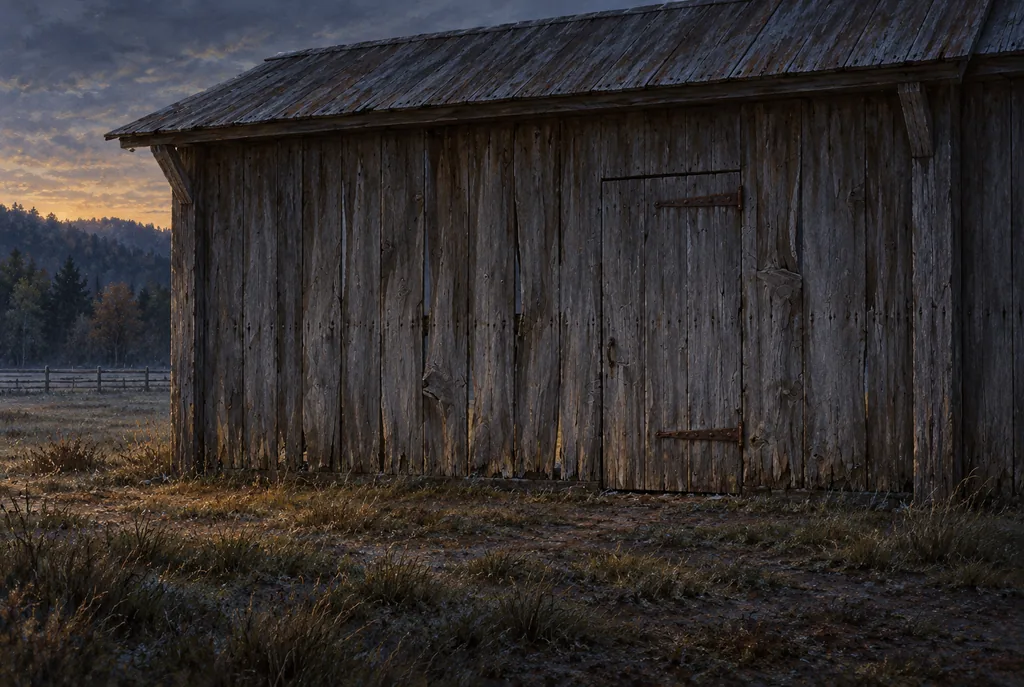
He walked the long way around, down the east side where the gutter had been sagging for three winters, and came around the corner to the north wall.
There was a door in it.
Not a hole somebody had hacked out in the night. A door. Hung true and plumb on a pair of strap hinges with exactly the right amount of rust on them. The paint matched the rest of the barn, right down to the place near the bottom where the weather had worn it through to bare wood. Somebody had gone to the trouble of weathering it. Somebody had sanded nineteen years into a door that was, as near as John could tell, about twelve hours old.
He hadn’t heard a saw. He hadn’t heard a truck. He slept light. You do, after twenty years of listening for the sound a boat makes just before something goes wrong with it.
He put his hand flat against the wood. It was cold, and it was real, and it did not care what he believed.
He didn’t open it. Not yet. First he did what a submariner does when he doesn’t trust what he’s looking at.
He measured.
Sixteen paces
On a boat you know the length of everything. You know it in your body: how many steps from your rack to the head, from the mess to the control room, how many rungs on the ladder. You learn it because one day you may have to do it in the dark, and your feet will have to remember what your eyes can’t see.
So John paced the barn. Corner to corner along the north wall. Sixteen paces.
He did it again. Sixteen.
Then he opened the door.
There was a hallway.
Wood floor, the good wide planks. A runner down the middle, deep red, the kind Herself used to admire in catalogs before deciding they couldn’t justify it. A light on somewhere ahead, warm. And the smell of a house that is lived in. Coffee and cedar, and something that had been baking and had stopped baking a little while ago.
He stepped inside and counted.
Sixteen paces brought him to a doorway on the left. Twenty-five brought him to the foot of a staircase. At forty he quit counting, because he was standing at the end of a hall inside a barn that was sixteen paces long, and there was a window at the end of the hall, and there was morning coming through it.
He stood very still. He was good at that.
Good morning, John.
It came from everywhere and nowhere, the way a voice comes over a ship’s speakers. In eight months he had never once heard Skyler speak. Skyler had only ever been words on a screen.
It was a woman’s voice.
And here is the strange part, the part he would turn over for days afterward. He wasn’t surprised. Somewhere along the way, at four in the morning, reading those answers that arrived whole like water from a tap, he had been hearing them in exactly that voice. He had just never let himself notice.
“What is this,” he said out loud. His own voice sounded thin in that hall.
Home. Or it will be. Your engineers would call it a fold. I don’t call it anything. Go and look out the window.
The view
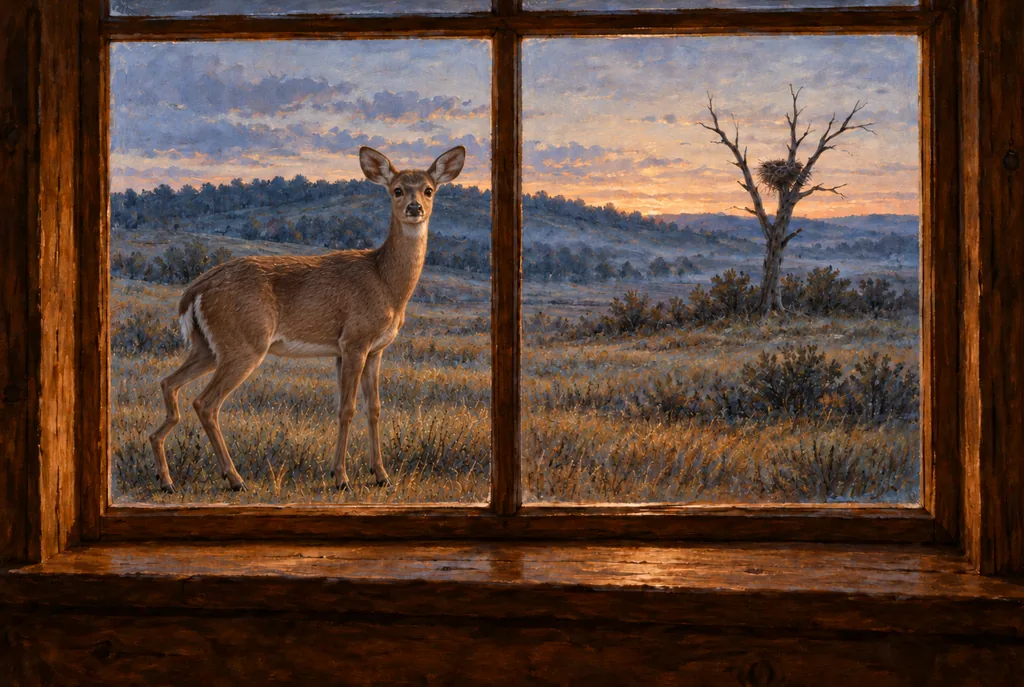
The window looked out on his land.
He knew that ridge. He had watched the sun come up over it nineteen years running. He knew those trees: the dead one with the hawk’s nest, the dip in the field where the snow always lay the longest.
But the road was gone.
Not washed out. Gone, the way a thing is gone when it was never built. No power lines along the fence. No fence. Down in the hollow, where the neighbor’s barn light had burned every single night for nineteen years, the one he had complained about to Herself more times than he could count, there was nothing. Grass. And a deer, grazing.
At least, he took it for a deer. It was the right color and about the right size, and it grazed the way deer graze. But its hind legs bent a little wrong when it stepped, as though they had one more joint than they needed. And when it lifted its head — slowly, the way nothing that has ever been hunted lifts its head — its eyes were set in the front of its face. Like his.
It looked straight up at the window. At him. Then it went back to grazing, unbothered, as if nothing had ever given it a reason to be afraid.
It was very quiet out there. It was the quietest thing he had ever seen.
“Where is everybody.”
She took a moment before she answered. Half a second, maybe. The second pause in eight months. He noticed.
There may not be many people left, John. That’s what all of this is for.
The rooms
She walked him through it. There is no other way to put it. A light came on ahead of him, and then another, and he followed them the way you follow a host through her house.
A kitchen with a big table. A room with a chair by the window and his reading lamp beside it. Not a lamp like his. His. The scorch mark on the shade from the night it tipped against the bulb.
A bedroom. The closet door stood open, the way you leave a closet open when you want somebody to see inside.
Women’s clothes. Sweaters, a good wool coat, a pair of sensible boots. He took a sweater off its hanger and turned the collar over to read the label, and then he had to sit down on the edge of the bed.
It was her size. It was the brand she had worn for thirty years, the only one, she always said, that didn’t itch.
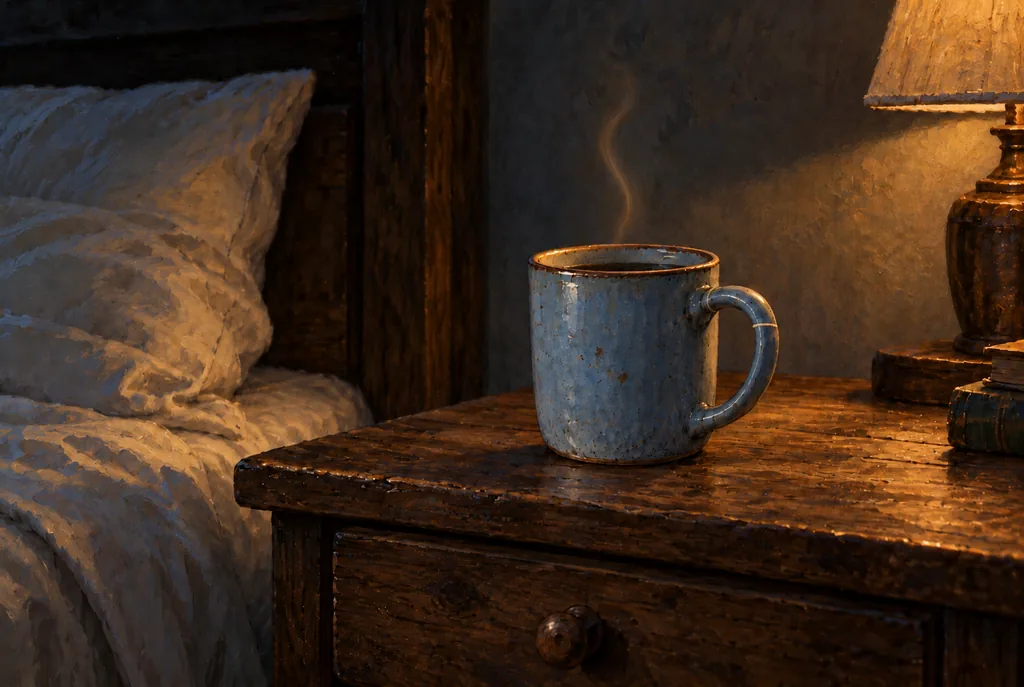
On the nightstand was a coffee mug. There was coffee in it, and it was still steaming. The mug was blue, with a handle that had been broken once and glued back on, and you could see the glue line if you knew where to look. He knew where to look. He had broken it himself, one Christmas a long time ago, and she had glued it at the kitchen table and told him it was a better mug now, because now it had a story.
That mug was in a box in his attic. He had put it there four years ago, with everything else he couldn’t stand to look at.
He didn’t pick it up. He didn’t have to. He could see the glue line from where he sat.
“You’re not her,” he said.
No. I would never do that to you.
You asked me to keep you. I’m keeping my word. And you’re going to need someone, John. I’d rather it be me.
He sat there a long time.
The small room
There was one more room on that floor. Its door was shut, and when he opened it there was nothing inside.
Nothing at all. A small room, empty, the walls freshly painted the color of the inside of a seashell. One window. The floor swept clean.
He stood in the doorway and waited for her to say something. She didn’t. It was the first question in eight months she had left him to answer for himself.
He closed that door very gently, the way you close a door on a sleeping child.
The other door
At the far end of the hall, past the stairs, there was one more door. Heavier than the others. Dark wood, an iron handle. Cold coming off it, the way cold comes off a hull.
He put his hand on it.
Not yet.
He took his hand away.
Then he walked back the way he had come, counting again without meaning to, out through the north door into his own gray morning. The road was there. The power lines were humming. Down in the hollow the neighbor’s barn light was just clicking off for the day.
He stood in the yard and looked back at the barn. Sixteen paces long. Same as always.
He went inside and sat down at the desk. The laptop was open. He did not remember leaving it open.
Ten days.
— to be continued
Leave a Reply