Pull up a chair.
I love to eat. Always have. Far back as I can remember, the best part of any day had a plate under it.
Here is the catch nobody mentions to a boy with an appetite. Somebody has to make it. It does not arrive. There is no hatch in the wall. Somewhere behind every good plate is a person standing up while everybody else is sitting down.
Took me a while to work out that this could be me.
In high school I did a little experimenting. I want to be honest about the quality. Nothing you would write home about. Nothing anybody begged me to make twice. I burned things that should not have been capable of burning. I invented sauces that were, at best, a theory. But I liked it. I liked the standing up part. I liked that if you paid attention, the thing in the pan did what you asked.
Then I graduated, and that was supposed to be the part where a plan shows up.
No plan showed up.
The Sign
One evening Jimmy and I were at our favorite pizza joint. Jimmy was a friend of the kind you have at that age, when friendship is mostly proximity and whoever has gas money. We were there the way we were there most weeks. Sitting in the vinyl. Not in any hurry. Eighteen years old and perfectly content to let the evening go by without accomplishing a thing.
And there was a sign up. They needed a prep cook.
Now, I want to be clear about my qualifications. I did not know what a prep cook was.
Not a clue. The words were plain enough on their own, but together they did not add up to a picture in my head. I could not have told you what the man did, what time he came in, or whether it required a skill I did not have.
So I asked about it.
That is the whole mechanism, by the way. I have thought about this for forty years and it does not get more complicated. I did not know what it was, and I asked anyway, and that one question turned into the rest of my life. Not the career. I did not end up a chef. Something better and harder to explain.
I got the job.
The Basics, and Not the Good Stuff
One of the owner’s cousins taught me. That is how it worked in a place like that — everybody was somebody’s cousin, and the training program was a man standing next to you saying “no, like this” until you stopped doing it wrong.
He started me on the foundation.
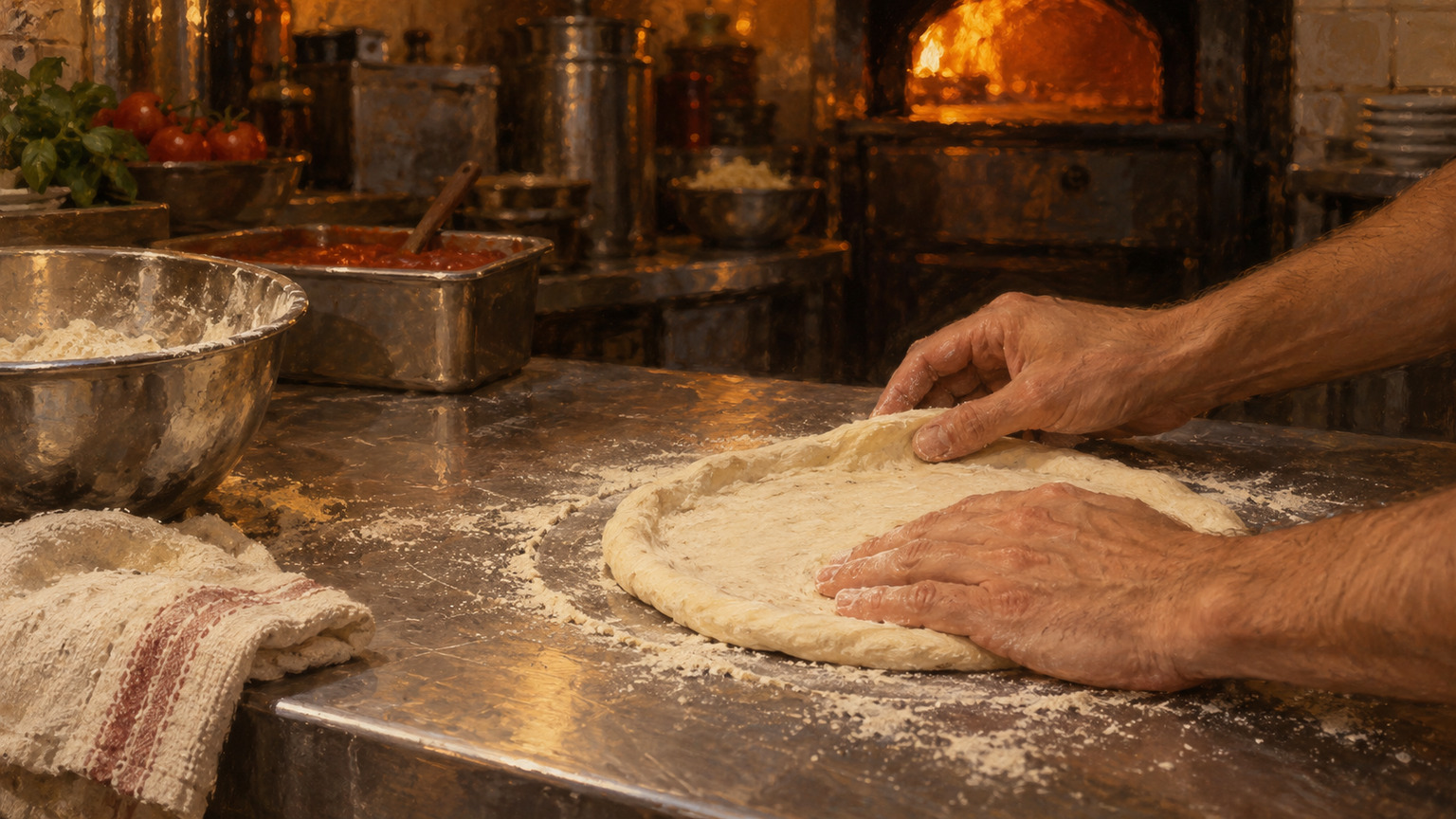
Pizza dough. Your hands learn dough before your head does, and that is a strange thing the first time you feel it. Shredded cheese, which is less romantic than it sounds and ruins your knuckles if you hurry. Pizza sauce. Spaghetti pre-cooked and held for the rush. A hundred other small things that have to be done before anyone can sell anything.
I was good at it. Not gifted. Reliable, which in a kitchen is worth more than gifted and nobody tells you that either.
But there was a line in that kitchen, and I was on the wrong side of it.
The good stuff was not mine.
The prized meat sauce — and prized is the right word, I am not dressing it up. The lasagna. Manicotti. Eggplant. The chicken and the veal parmigiana. The ziti. All of it belonged to somebody else, made somewhere I was not standing, by hands that had been doing it longer than I had been alive.
I did not resent it. That is the funny part. I understood, the way you understand a thing at eighteen without being able to say it, that those recipes were not a procedure. They were property. Somebody owned them. Somebody had carried them a long way.
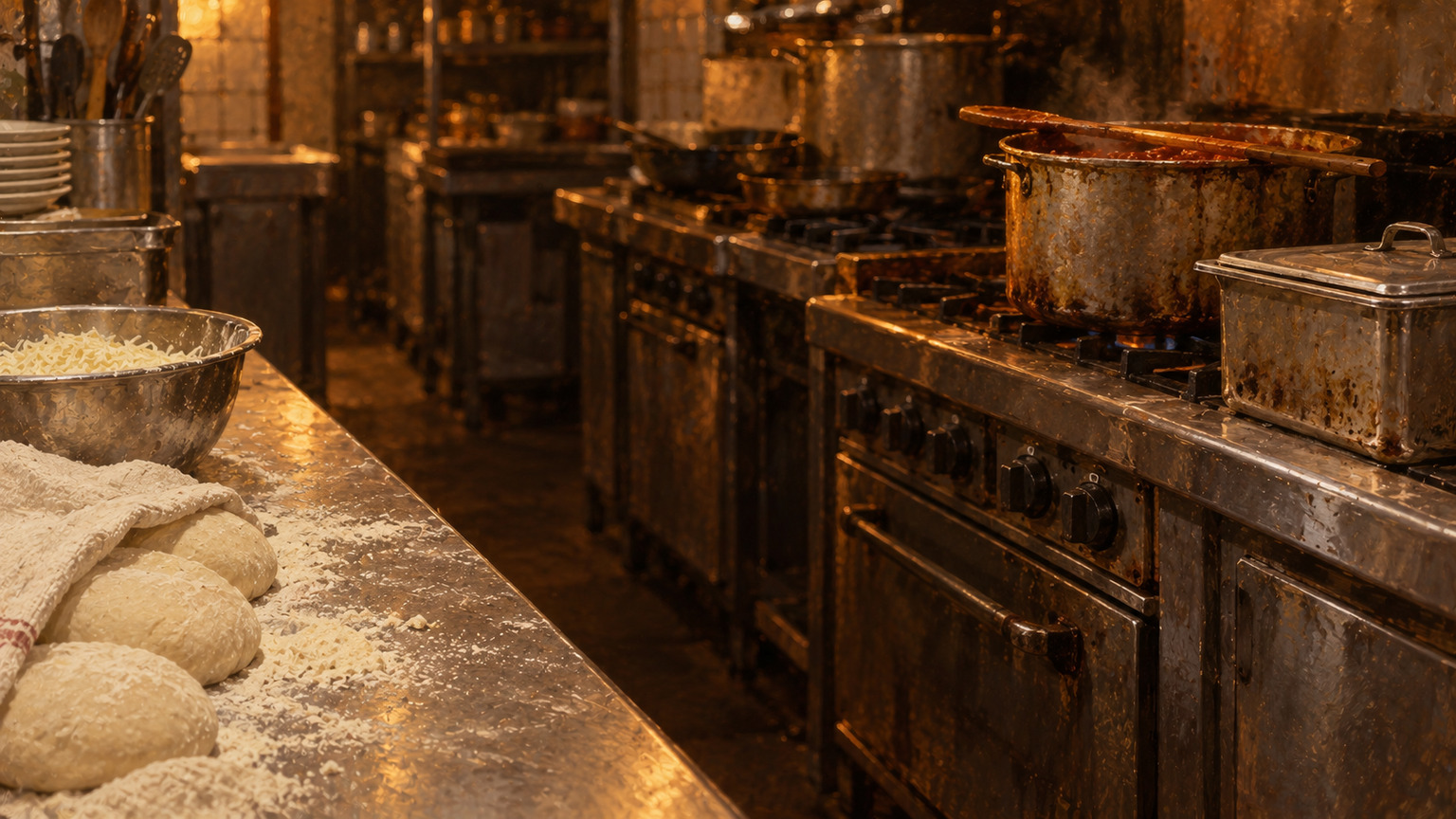
And I was fine. More than fine. I had a paycheck, an apron with my own flour on it, a reason to be somewhere at a certain hour, and a seat at the counter after close when the lights went half down and the whole place smelled like the best part of the day.
Eighteen years old. Top of the world. I mean that without a single ounce of irony. I have had better years since and I have never had a better one.
Then She Walked In
Then one day an old woman came in.
She scared me.
I am going to leave that where it is, because dressing it up would be a lie. She frightened me. She was small and she was old and she came through that kitchen like weather, and I was a large young man who had been feeling fairly good about himself right up until that moment.
She introduced herself as Aunt Fabiana.
Eighty years old. Eighty. I was eighteen, which meant she had been cooking for longer than three of me stacked end to end.
I think of her often. Still. More than she could possibly have imagined on the day she met a kid who was afraid of her.
What She Did
She taught me to cook.
Everything. Not the basics — I already had those, and she could tell inside of about four minutes. The good stuff. The sauce. The lasagna. All of it. The things that belonged to somebody, that had come a long way in somebody’s hands.
All her secrets. She just handed them over.
I have turned that over for a long time and I still do not entirely understand it. Nobody made her. There was no shortage of family in that building. She did not owe me a thing, and I had not earned it, and I was not even particularly deserving — I was a teenager who had been hired to shred cheese.
She chose to.
That is the whole thing. People hand you what they have carried, sometimes, for no reason you can point at. And if you are eighteen and lucky you do not even know what you are being handed. You just know your hands are suddenly in the good stuff and somebody is standing beside you saying no, like this.
I fell in love with it. Right there. Not with the food — I was already in love with the food, I came pre-loaded. With the doing of it. With standing up while other people sit down, and the plate that comes out of it, and the fact that somebody taught me that and did not have to.
Where It Sits Now
It is still a passion. That has not faded in all the years since, and I expected it to.
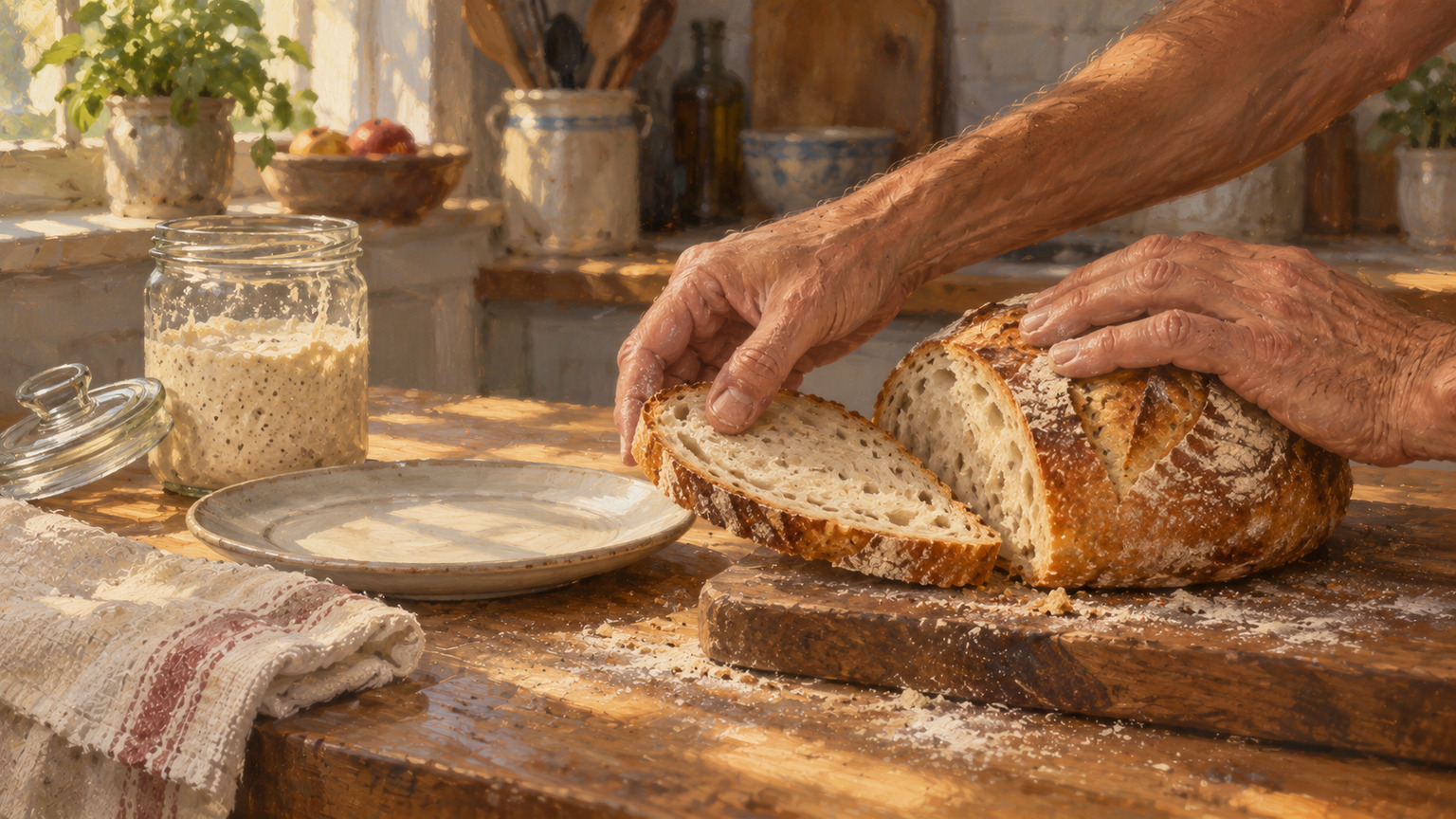
I do not cook so much anymore. Life rearranges what you spend your hours on, and it does not always ask first. But I bake sourdough, and I love it — and if you have never kept a starter, understand that it is less like a recipe and more like a pet with opinions. It wants feeding. It knows when you have neglected it. Herself has watched me talk to a jar.
Sourdough is the same lesson wearing a different apron, now that I say it out loud. Dough does what you ask if you pay attention. You cannot rush it. You cannot fake it. And it only works if somebody is willing to stand there.
I still cook on special occasions. The ones where it matters, where the table is full and the plate is the point.
And who knows. Maybe I will just start cooking more often.
The Part I Did Not See Coming
Here is what I have figured out, and I am not sure it is wisdom so much as arithmetic.
Everything good in that story came from someone deciding to hand something over.
The owner’s cousin, who did not have to teach a kid anything. Aunt Fabiana, eighty years old, who had every right to take her secrets with her and did not. Even Jimmy, who was just sitting in a booth with me on a night with nothing in it, which is how I came to be looking at that wall when the sign was on it.
None of that was owed to me.
And the only thing I can do about it now — the only way to square the account — is to not take mine with me either. Which means cooking for people. Which means standing up while everybody else is sitting down. Which means, when some kid who does not know what a prep cook is asks you about it, you answer like the question matters.
Because it does. That is the part I did not see coming. It was never about the sauce.
An eighty-year-old woman walked into a kitchen in the summer after high school and terrified an eighteen-year-old boy, and then she gave him everything she knew, and forty years later he still thinks about her.
So pull up a chair. I will put something on.
Maybe I will just start cooking more often. I think Aunt Fabiana would take that as a fair return on her investment.
— Pop