The morning charter cancelled twenty minutes before we were supposed to leave the dock. Two tourists from Ohio had looked at the forecast, decided the “chance of afternoon storms” was a personal insult, and walked away like I’d planned the weather just to inconvenience them. I stood on the stern of the Mary Anne with a coil of line in my hands and watched them go. I didn’t blame them. I just didn’t feel like going back to the house.
The house was always there, waiting. Marlene’s car in the drive. Troy’s music bleeding through the walls like a slow leak. That particular quiet that settled over everything the moment I stepped inside — the kind that made it clear I was furniture with a pulse. I’d rather be on the water with nothing to do than sit at that kitchen table pretending I belonged there. Pretending had never been one of my stronger skills.
So I cast off anyway.
The day was clean and bright, the kind of Keys morning that made the water look like somebody had poured glass and forgotten to tell it to stop being beautiful. I ran the usual channel for a while, then cut west toward a scatter of mangrove keys most people never bothered with. One of them was barely more than a sandbar with a thicket of sea grape and red mangrove. I’d passed it a hundred times and ignored it every single one. Today I killed the engines a hundred yards out and let the tide do the work. Figured if I was going to waste a morning, I might as well waste it somewhere new.
The skiff kissed the sand with a soft grind. I stepped out into warm, ankle-deep water and walked the short beach, more out of habit than purpose.
That was when I saw her.
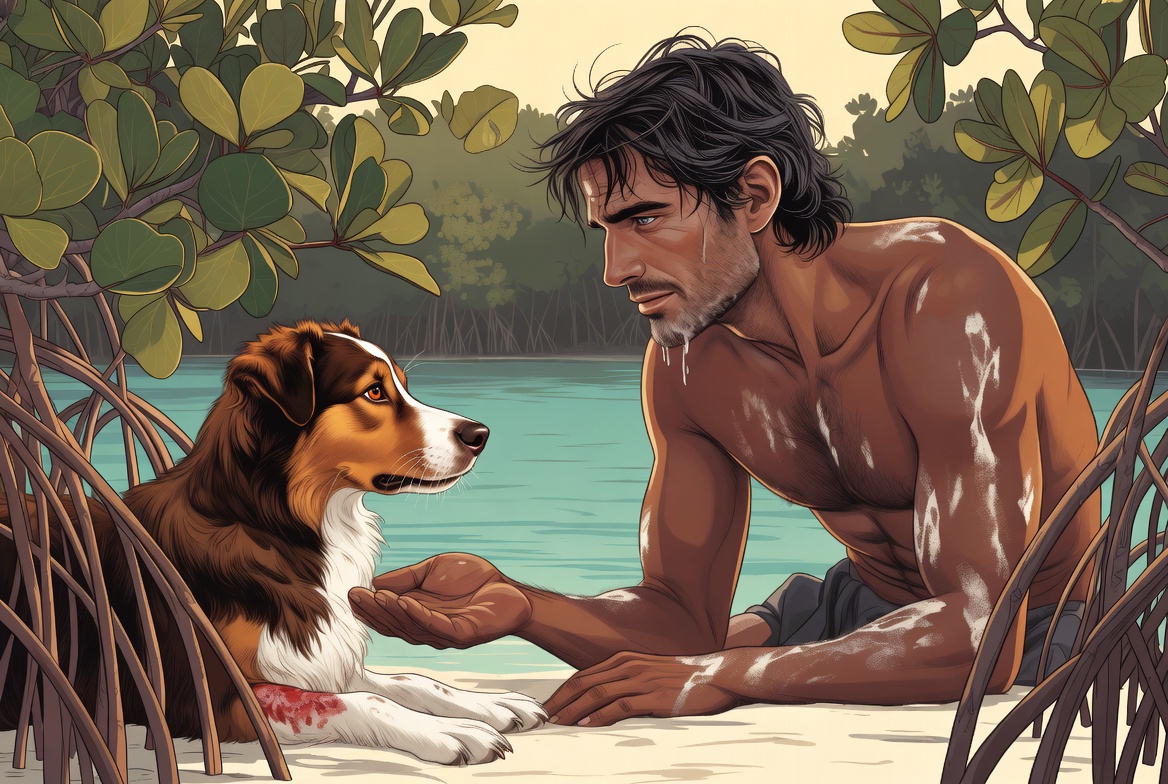
A shape under the sea grape. Red and black and white. Not moving right.
I stood over the dog for a long minute, hands on my hips.
“Well, shit,” I said. Eloquent as always.
She was young. Eight or nine months, maybe. Red tricolor, the kind of coat that looked expensive even when it was filthy and matted with salt. One hind leg was held at an angle that made my stomach do something unhelpful. Her cinnamon eyes tracked me but she didn’t growl. Just watched, breathing shallow.
No collar. No tags. Of course not. That would’ve been too convenient. I ran my hands over her carefully, talking the whole time in the low, nonsense voice I used on nervous fish and nervous people.
“Easy. I got you. Not gonna hurt you more than you already are. Which, for the record, looks like plenty.”
She let me. That was the first strange thing. Most hurt dogs had opinions about strangers — usually the biting kind. This one just endured it, like she’d already decided I was the available option and she was too tired to argue. Smart dog.
I wrapped her in an old towel from the dry box and lifted her into the skiff. She was lighter than she should have been. Fever-warm. I kept one hand on her ribs the whole way back, feeling the quick rise and fall, and tried not to think about how many things out here could break a dog this bad and leave her alive. The Keys were beautiful. They were also excellent at killing things that didn’t belong.
At the dock I carried her to the truck, then to the little veterinary clinic that still took walk-ins if you looked pathetic enough. I apparently looked plenty pathetic. The tech scanned for a chip. Nothing. They cleaned the leg, splinted it, ran fluids, gave me antibiotics and a look that said they didn’t expect to see the dog again. I paid cash and took her home to the boat anyway. Optimism. Or stubbornness. Hard to tell the difference some days.
That first night she slept in a nest of blankets in the V-berth while I sat in the companionway with a beer that went warm in my hand. Every time she made a sound I was up. Every time she didn’t make a sound I was up anyway. The worry settled into something heavier as the hours passed. The leg wasn’t improving the way the vet had promised. Her eyes stayed bright, but her body was losing ground. I sat on the cabin sole with her head in my lap and felt the familiar, helpless anger that always came when something was breaking and I couldn’t stop it. I’d gotten real good at that particular flavor of useless over the years.
I didn’t call anyone. There was no one to call.
Saela came at dusk.
She never knocked. She never needed to. One moment the dock was empty, the next she was stepping aboard like the boat had been waiting for her. She wore the same faded blue shirt she always wore when she meant to stay a while, sleeves rolled, feet bare. The air around her smelled faintly of rain on hot stone. I’d stopped trying to figure out how she did that years ago. Some questions only led to more questions, and I already had enough of those.
She looked at the dog for a long time without speaking.
I didn’t look up. “She’s not getting better.”
“I know.”
Of course she knew. Saela always knew when something in me went tight and wrong. I’d stopped asking how a long time ago. The answers were never simple, and simple was in short supply around her.
She knelt on the other side of the dog and put one hand on the splinted leg. Her eyes — usually the color of water over white sand — went a shade deeper. I felt the change in the cabin the way you feel a drop in barometric pressure before a storm. Nothing dramatic. Just a quiet gathering of attention, like the world had leaned in to listen.
“What are you doing?” I asked.
“What you can’t.”
I should have argued. I usually did when she stepped into my life without invitation. Tonight I only watched. Pride was a luxury, and the dog was running out of time.
Saela worked in silence. Her hand never moved, but the dog’s breathing slowly evened. The fever heat under my palm cooled by degrees. The tight, pained look around the cinnamon eyes loosened. It took the better part of an hour. When she finally sat back, the dog sighed once and slept like something that had been given permission.
I kept my voice low. “You fixed it.”
“I reminded her body what it was supposed to be.” Saela flexed her fingers as if they ached. “She was already trying. She only needed the weight of a clearer memory.”
I didn’t understand the words, not really, but I understood the result. The dog was going to live. I’d take the win and figure out the rest later. Or never. Never was always an option.
Saela stayed the night. She sat in the opposite corner of the cockpit with a cup of tea she had produced from somewhere, and we listened to the water slap against the hull. At one point she said, almost to herself, “She chose you. Or something in you called her. I’m not sure there’s a difference anymore.”
I didn’t answer. I was watching the rise and fall of the dog’s side and feeling something unfamiliar and careful open in my chest. I didn’t trust it. Things that opened had a habit of getting broken.
On the third morning the splint came off. The leg held. By the end of the week the limp was only a memory. I told myself it was clean bandages and young bones and luck. I told myself that a lot. It was easier than the alternative.
I started calling her Pip because it was short and didn’t ask anything of either of us. Later, when the name had already stuck, I stretched it to Pippa in the quieter moments, like it was a secret. Dogs didn’t need secrets. People did. I had plenty to spare.
The bond grew the way tide marks rise on a piling — slow enough that you only notice when you look back and realize how high the water has climbed. At first it was only the sense that she was always aware of where I was on the boat. Then it became the way she would appear at my side a second before I realized I wanted the company. Then it became something deeper, a low steady awareness that felt less like training and more like recognition. I didn’t examine it too closely. Examining things had never done me any favors.
One evening, nearly two weeks after I’d found her, I was mending a net on the foredeck. Pip lay a few feet away, head on her paws, cinnamon eyes half-closed. The light was going gold across the water. For no reason I could name, I looked up and found her already watching me.
Not waiting for a command. Not hoping for food. Just watching, steady and present, as if she had decided that wherever I was, that was the place she needed to be.
Something shifted in my chest — small, careful, almost unwilling. I reached out and scratched the soft fur behind her ear. She leaned into my hand without breaking eye contact.
“Yeah,” I said quietly. “I see you too.”
Pip’s short tail gave one slow thump against the deck.
Saela never brought up what she had done that first night. She only watched the two of us, when she came, with an expression that was equal parts satisfaction and something older and sadder. I never asked. Some things you leave alone when they’re still working. I’d learned that the hard way. More than once.