
My grandkids call me Asshat. Affectionately, they tell me. I’m seventy years old, I spent the better part of my working life sealed in a steel tube under the ocean with a hundred and fifty other men who smelled like diesel and regret, and I’ve been asked more times than I can count whether I ever saw anything “weird” down there.
Here’s the honest answer: I saw plenty of weird. Most of it was the cook.
But that’s not what you’re asking. You’re asking about the little green men. The lights in the sky. The stuff the cable channels run at two in the morning between the ads for reverse mortgages and catheters. You want to know if a man who spent twenty years listening to the ocean through a hydrophone ever heard something that didn’t belong.
Yeah. Once.
I’ll tell you about it, but first you need to understand something about submarines, because most of what you think you know came from a movie with Sean Connery doing a Scottish-Russian accent.
A boomer—a ballistic missile sub—doesn’t hunt anything. Her whole job is to disappear. You go out, you sink into the black, you drive slow circles in a patch of ocean nobody knows about, and you wait for a message you pray never comes. Seventy days of that. No sun. No news. No phone call from your wife. Just the hum of the plant, the smell of amine, and the same eleven movies on the mess deck TV.
I wasn’t a sonarman. I was the computer tech for comms—the guy who kept the gear alive that would have told us the world was ending. But on a boat everybody wanders, and I had a buddy in the sonar shack named Dutch who let me sit in the back and drink his coffee on the midwatch.
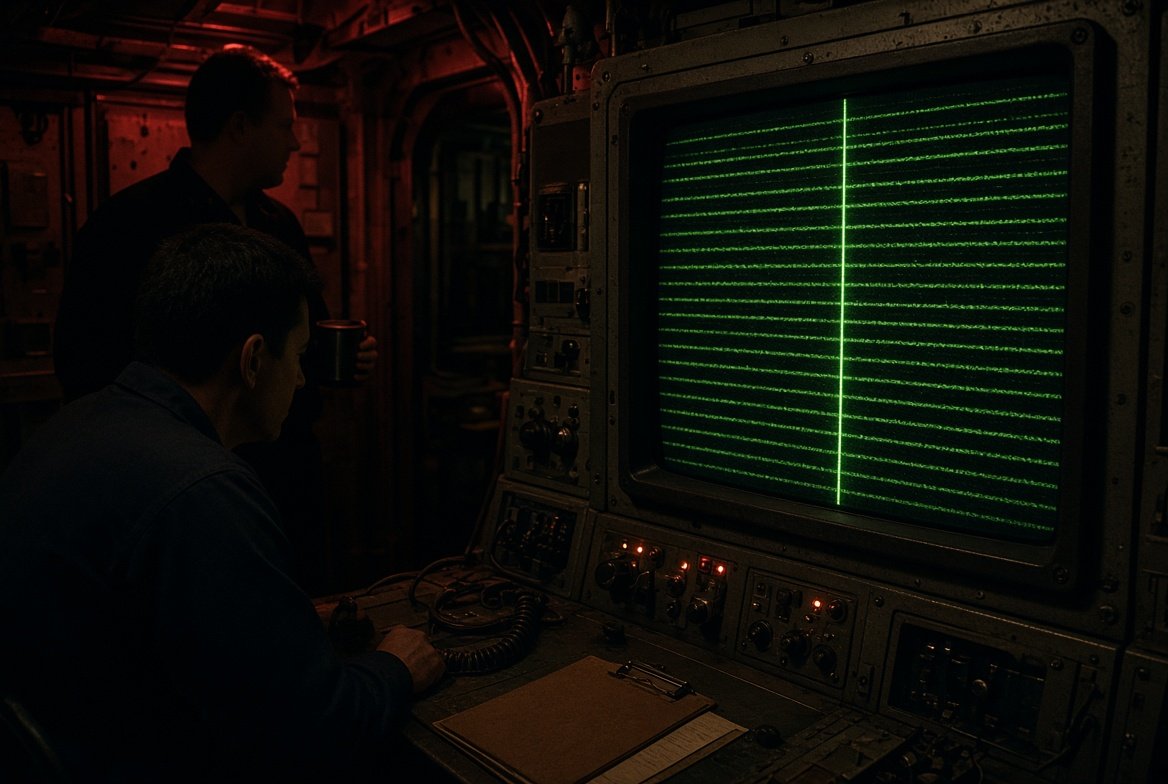
Sonar on a submarine isn’t a green screen with a sweeping line. That’s surface ships, and that’s active—pinging, which we never did, because pinging is like flicking your Bic in a dark room and yelling “here I am.” We listened. Passive. A boomer is the best set of ears ever built, and the men who run those ears can tell you a merchant’s screw count, how many blades, and whether she’s got a bent shaft, from forty miles out. They know what whales sound like. They know what shrimp sound like—a frying pan full of bacon, if you’re curious. They know the ocean like I know the inside of my own eyelids.
So when Dutch sat up straight at 0300 and said “Huh,” I paid attention. Sonarmen don’t say “huh.”
It was a tone. Not a screw, not biologics, not the ice groaning or a seamount doing whatever seamounts do. A single clean tone, low, way down where the big freighters live, but steady like nothing man-made is steady. Diesels throb. Steam whines. Screws cavitate. This thing just held, the way a tuning fork holds, if a tuning fork was the size of a football stadium.
Dutch got the chief. The chief got the OOD. The OOD got the captain out of his rack, which nobody does at three in the morning for a whale.
Bearing was constant. Range, by the math, was closing.
Now here’s the part that’ll stand your hair up if you know boats. Nothing closes on a Trident. Nothing finds a Trident. We were quieter than the water around us; that was the whole point of the taxpayers’ several billion dollars. And this contact wasn’t searching—no bearing drift, no sprint-and-drift, no pattern. It was coming straight down the line like it had our address and a casserole.
Captain took us deep and quiet. I don’t mean quiet like a library. I mean the cook stopped cooking. Men in their racks stopped breathing loud. I stood in the back of the shack with Dutch’s cold coffee going sour in my mouth and watched the waterfall display paint that tone, line after line, straight as a plumb bob.
The chief said, real low, “It’s got no Doppler.”
Which means, for you civilians: a thing moving toward you goes up in pitch, a thing moving away goes down. Everybody’s heard the ambulance. This thing was closing—the numbers said so—and the pitch never moved a hair. Physics doesn’t do that. Or it does, and the thing was moving in some direction sonar doesn’t have a word for.
I’m an Orthodox Christian. I say that so you understand I don’t have any need for aliens. My universe is already full; it’s got angels and saints and things in it I can’t see, and I made my peace a long time ago with not understanding most of it. I’m not a UFO guy. I’ve never watched the shows. I think most of the people who “saw something” saw Venus, or a weather balloon, or the bottom of a bottle. I’m telling you what I heard, at three in the morning, at depth, with men around me who’d bet their lives on their ears.
It went silent on the bearing at about two thousand yards. Not faded. Not turned. Stopped. Like somebody pulled the plug.
We sat there an hour. Two. Nothing. Dutch’s hands were shaking, and Dutch didn’t shake. The captain finally stood us down, told the OOD to log it as “unidentified biologic, probable,” which is Navy for “I’m not putting the real thing in writing.” Then he went to his stateroom, shut the door, and I didn’t see him for a day.
That was 1987. I’ve never told anybody outside the family, mostly because I know what it sounds like.
But here’s the thing that’s kept me up for thirty-nine years, and it isn’t the tone.
It’s what Dutch said to me a week later, in the torpedo room, where nobody could hear. He said the tape—the sonar recording, the one that went in the safe—he’d listened to it one more time before it got sealed up.
He said under the tone, buried way down where you’d need a good set of ears and a bad night’s sleep to find it, there was a second sound.
He said it sounded like it was counting.

Leave a Reply